
Reviewed · WALKING TOURS IN JERUSALEM
Private Walking Tour in Jerusalem’s Old City
Jerusalem reveals itself one stone at a time. This six-hour private walk with licensed guide Orna Simchi connects the Old City’s four quarters with the sacred places of Judaism, Christianity, and Islam. I like the way the tour joins major sights with smaller stories, including local merchants, an Arab spice shop, Armenian ceramics, and the unusual past of the Notre Dame hotel.
I also like the private format, which lets your group of up to eight ask questions and shape the day around its interests. The main consideration is the pace: six hours on foot, with strict dress rules and possible changes to Temple Mount access. The $650 group price is strong value for six to eight people, but less attractive for a couple or solo visitor.
In This Review
- Key points at a glance
- Why this private Jerusalem walk works
- Jaffa Gate sets the story in motion
- The Armenian Quarter and St. James Cathedral
- Jewish Quarter stories, from the Cardo to Hurva
- The Western Wall and a useful correction
- Temple Mount: sacred ground and difficult questions
- The Muslim Quarter, spices, and everyday Jerusalem
- Following the Via Dolorosa to the Holy Sepulchre
- Armenian ceramics, coffee, and local conversations
- The newest gate and Notre Dame’s rooftop view
- Is $650 a fair price?
- Who should book this Old City tour?
- Should you book it?
- FAQ
- Where does the tour begin?
- Where does the tour end?
- How long does the tour last?
- How many people can join the private tour?
- Is the tour led by a licensed guide?
- Are entry fees included?
- Is food or coffee included?
- What should I wear?
- Is Temple Mount open every day?
- Can the tour be tailored?
Key points at a glance
- Three faiths in one walk: See the Western Wall, Temple Mount, Via Dolorosa, and Church of the Holy Sepulchre in one carefully connected route.
- Orna Simchi leads the tour: She is a Ministry of Tourism certified guide with more than ten years of experience and a reputation for clear storytelling and humor.
- Private groups only: Your party of up to eight gets the guide’s full attention, with the option to tailor the day to your interests.
- Small local stops matter: The route includes an Arab spice shop, a possible meeting with local merchants, Armenian ceramics, coffee, and cake.
- Temple Mount access can change: The site is closed to visitors on Fridays, Saturdays, and various Muslim and Jewish holidays. A viewpoint is used instead.
- The rooftop finish is memorable: Notre Dame of Jerusalem Center offers a broad view over the Old City, Temple Mount, Mount of Olives, and newer Jerusalem.
Why this private Jerusalem walk works
The Old City can feel like a maze of narrow lanes, religious boundaries, market stalls, and monuments layered on top of one another. A guide gives those layers an order. Orna’s route is built around questions: who built the walls, why a quarter exists, how a synagogue survived, and why one holy site can matter so differently to three faiths.
That approach is more useful than simply collecting photographs. At the Western Wall, for example, you learn why it is not Judaism’s holiest place, even though it is the most recognizable Jewish prayer site in Jerusalem. At Temple Mount, you look at the same ground through Jewish and Muslim religious history, while also hearing about archaeology, political conflict, and competing hopes for the future.
The private format matters here. You can pause when a subject needs more explanation, ask about biblical references, or spend less time on a site you have already seen. It also helps groups with different ages and interests. Orna has worked with people from their 30s through their 70s, and her style includes humor as well as detailed explanation.
One practical warning: this is not a casual stroll. The route lasts about six hours and covers uneven Old City streets. Wear comfortable walking shoes, carry water, and bring a hat. A private guide can adjust the focus, but the basic walking demands remain.
More Walking Tours in Jerusalem
- Jerusalem: Guided Walking Tour of the Old City
★ 4.7 · 386 reviews - All Inclusive Walking Tour Old City Jerusalem
★ 5.0 · 83 reviews - Jerusalem Walking Tour: In the Footsteps of Jesus
★ 4.5 · 67 reviews
Jaffa Gate sets the story in motion
The tour begins at Jaffa Gate, one of the clearest entry points into the Old City. The opening half hour focuses on the walls, the gate’s name and purpose, and what the area looked like in earlier periods.
This is a good place to begin because the walls give you a physical sense of Jerusalem’s defensive past. Orna also raises less obvious questions, such as who built the walls, when they were built, why the city wall was breached for an honored guest, and who lies in the mysterious tombs near the gate.
The admission cost here is free, but the value comes from interpretation. Without a guide, Jaffa Gate can be just a place to meet. With context, it becomes an introduction to the city’s rulers, visitors, religious claims, and changing shape.
The Armenian Quarter and St. James Cathedral
The Armenian Quarter is quieter than some of the Old City’s main routes. The 20-minute stop centers on the courtyard of St. James Cathedral and the reasons the Armenian community has its own quarter.
You will hear who James was, who built a wall around the quarter, and how the Armenian Patriarch raised money for the cathedral’s renovation. These details help explain that Jerusalem is not divided into simple Jewish, Christian, and Muslim blocks. Christian communities also have distinct identities, traditions, and spaces.
This stop is brief, so it works best as a focused introduction rather than a long visit. If Armenian history is especially important to you, the private format gives you a chance to ask Orna for more detail.
Jewish Quarter stories, from the Cardo to Hurva
The Jewish Quarter receives about an hour, making it one of the more substantial parts of the walk. You visit the four Sephardic synagogues and hear how they were built and connected to the story of a man who escaped besieged Jerusalem in a coffin to preserve Jewish religious life.
That story gives the quarter a human scale. You are not just looking at restored buildings. You are considering how people maintained religious identity during siege, displacement, and hardship.
The route also includes the Cardo, the old street whose remains offer a different view of Jerusalem’s past. Then comes the Hurva Synagogue and the story of Jews who traveled from Europe to Jerusalem while waiting for the Jewish Messiah to return. These stops show how Jerusalem has drawn communities with very different backgrounds and expectations.
Entry fees are included, which is useful in this part of the tour. The four Sephardic synagogues are replaced with another synagogue on Fridays, so the exact visit changes by day. That is worth checking if those particular synagogues are a priority.
A completely different kind of day:
- From Tel Aviv: Jerusalem and Bethlehem Guided Day Trip
★ 4.3 · 1,316 reviews - Tel Aviv: Jerusalem, Bethlehem & Dead Sea
★ 4.0 · 881 reviews - From Tel Aviv: Jerusalem Old & New City Bus Tour
★ 4.2 · 824 reviews - From Jerusalem: Masada & Dead Sea Full Day Tour with Pick Up
★ 4.5 · 815 reviews
The Western Wall and a useful correction
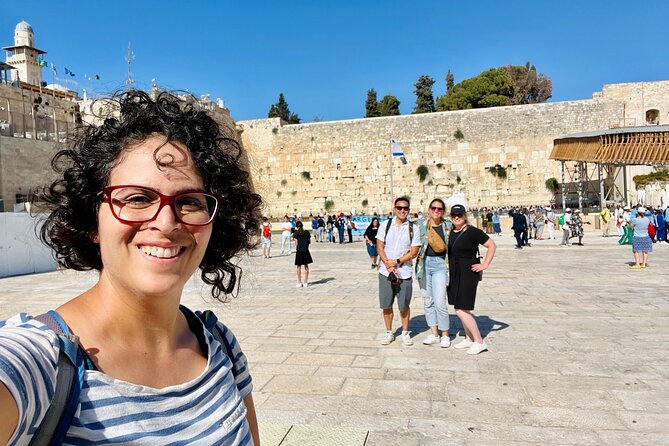
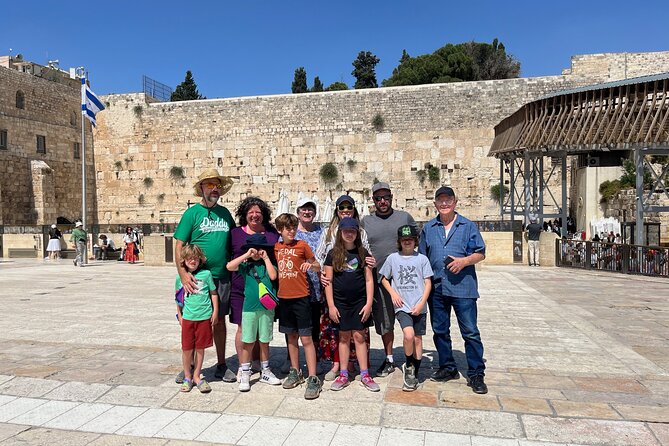
The Western Wall stop lasts about 20 minutes. You visit the broad prayer area and learn who built the wall, how it was constructed, and why it is not the holiest Jewish site.
That last point is important. Many first-time visitors assume the Western Wall is Judaism’s central sacred place because it is the most visible site open to public prayer. Orna’s explanation separates the wall itself from the Temple Mount above it, helping you understand why the two places carry different religious meanings.
Dress modestly here. Tank tops are not suitable, and pants or skirts should reach the knees. This is a short stop, but it may be emotionally powerful, especially when you see people praying close to the ancient stones.
Temple Mount: sacred ground and difficult questions
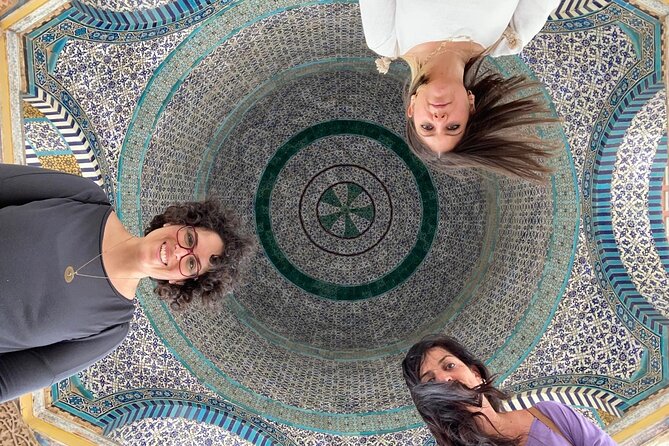
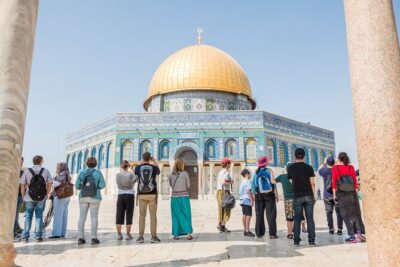
Temple Mount receives about an hour and is the tour’s most sensitive section. The site is sacred in Judaism and Islam, and access rules can change. Since the destruction of the Second Temple in 70 AD, Jews did not control the mount until 1967, after the Six Day War.
Orna uses the site to explain how the mountain became sacred to the monotheistic religions. The discussion also includes illegal excavations, the project that sifted soil from the Temple Mount to recover archaeological material, Messianic Jewish hopes for a Third Temple, and Muslim graves found in a place considered Judaism’s holiest ground.
This is where a guide is especially helpful. The subjects can quickly become political or emotionally charged, and a clear timeline gives you a better way to understand the competing claims. You should expect a serious section rather than a simple monument visit.
Temple Mount, including the Dome of the Rock and Al-Aqsa Mosque, is closed to visitors every Friday and Saturday and during various Muslim and Jewish holidays. On those dates, the tour uses a viewpoint overlooking the mount instead. The substitute still supports the discussion, but it is not the same as entering the site.
The dress requirements are stricter than at other holy places. Men need pants below the knees and a T-shirt. Women need a long skirt or pants that are not skinny, plus a long-sleeved shirt with no cleavage. A skirt may be provided if you do not have a cover, but it is simpler to arrive dressed appropriately.
Do not bring holy books, sacred objects, weapons, laptops, tablets, iPads, alcohol, or musical instruments into Temple Mount. These rules can shape your packing for the day.
The Muslim Quarter, spices, and everyday Jerusalem
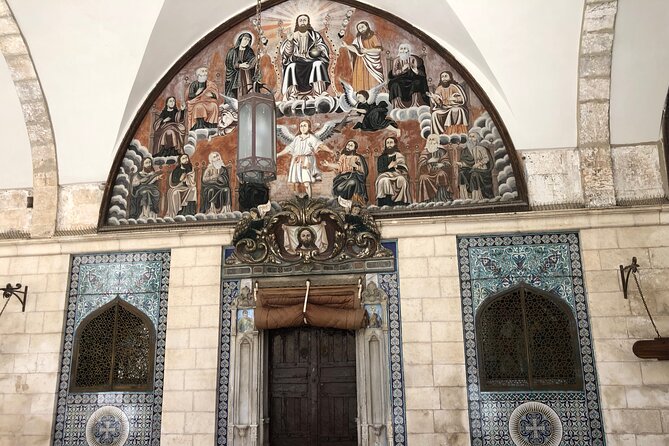
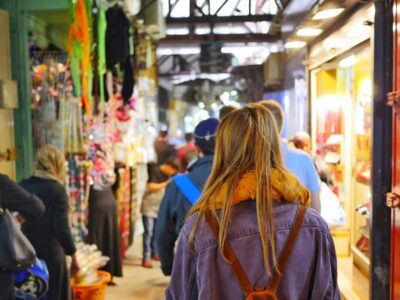
After the Temple Mount, the route moves through the Muslim Quarter and Arab market. The half-hour stop covers who built the quarter and why, then adds a more sensory encounter at a local spice shop.
You get to try Arab sweet delights, which is a welcome change after so much stone, chronology, and religious discussion. Small food stops can make a long walking day feel more personal. They also give you a chance to see commerce and daily life rather than only famous monuments.
The market portion is not presented as a shopping expedition. It is a short local encounter within the larger route. If you enjoy buying spices or sweets, you may want to ask Orna how much time is available, since the tour has many stops to cover.
Following the Via Dolorosa to the Holy Sepulchre
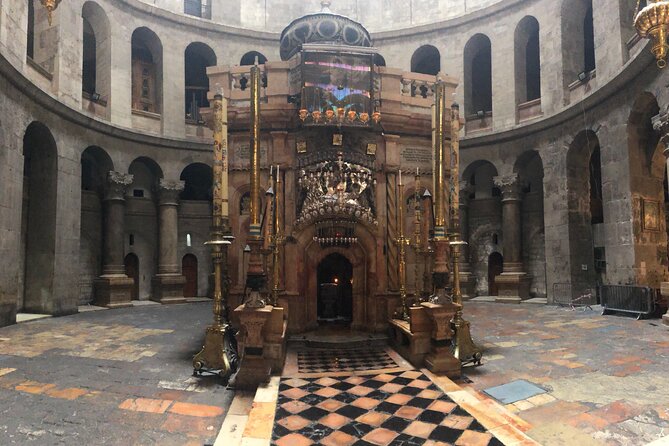
The walk along the Via Dolorosa includes some of the stations on the way to the Church of the Holy Sepulchre. This section lasts about 20 minutes, so it is a passage through the route rather than a detailed study of every station.
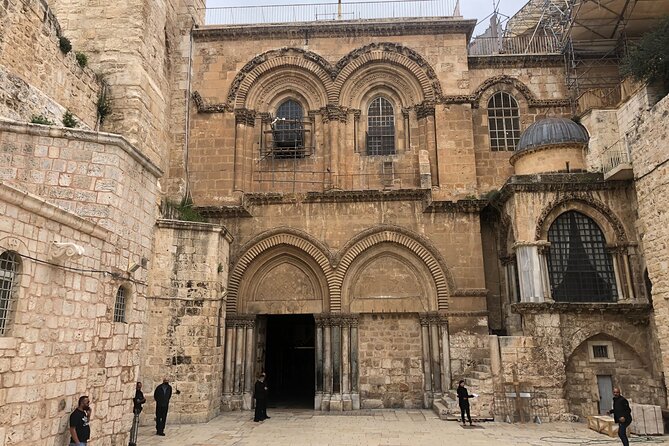
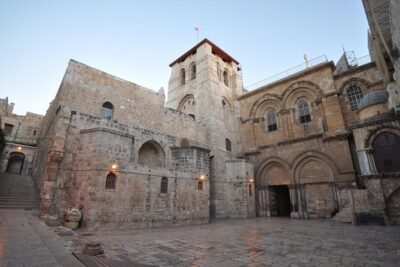
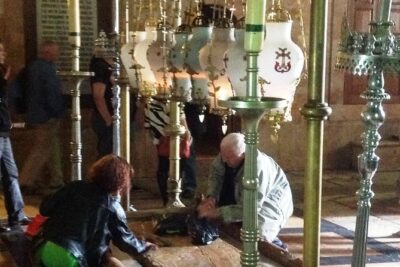
The Church of the Holy Sepulchre receives about 45 minutes. For Christians, this is the place associated with Jesus’ crucifixion and burial. You visit the area of the crucifixion and the tomb, while Orna explains the Christian meaning of the site.
The church can feel confusing without help because several Christian traditions share responsibility for it, and the sacred spaces are close together. A guide can point out what you are seeing and keep the visit from becoming a rushed walk through a crowded religious building.
Dress modestly here too. Tank tops are not appropriate, and knees should be covered. Since holy places may enforce rules at the entrance, wearing suitable clothing from the start is easier than trying to improvise.
Armenian ceramics, coffee, and local conversations
The Christian Quarter stop adds about 45 minutes of less formal sightseeing. You hear about a patriarch who locked himself in his room and received food through a window, then stop at an Armenian ceramics shop.
The route also includes cake and coffee at a local cafe. That food is not included in the tour price, so bring some cash or another way to pay for the refreshment. This is the one clearly listed extra cost.
There may also be a chance to meet local merchants, depending on who is available. That small qualification matters. You should treat the conversation as a possible bonus, not a guaranteed private meeting.
The stop includes a story about Jerusalem’s lowest statue, another reminder that the tour aims to collect odd, memorable details alongside major religious sites. That storytelling style is a key strength. Orna has been praised for making centuries of history easy to remember, keeping the tone entertaining without turning the subject into a lecture.
The newest gate and Notre Dame’s rooftop view
The route includes a stop at the newest gate in the Old City walls, with an explanation of why it was needed and when it was built. The supplied schedule does not assign a separate duration to this point, so it appears to be a short transition stop.
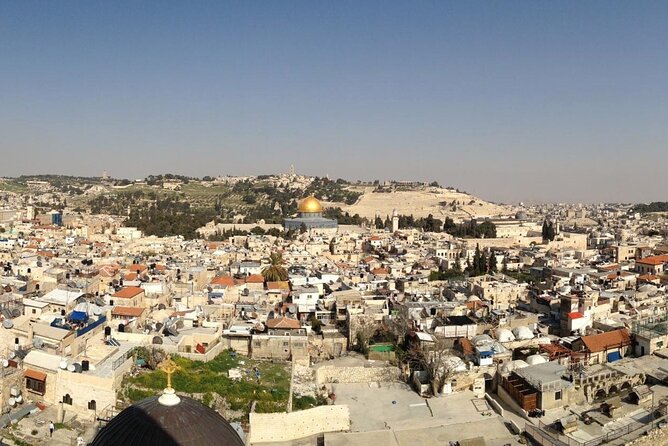
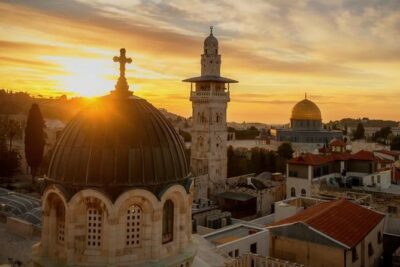
The walk ends at Notre Dame of Jerusalem Center, also called Our Lady of Peace in the tour description. The final 30 minutes take you up to the hotel roof for a wide view of the Old City and newer Jerusalem.
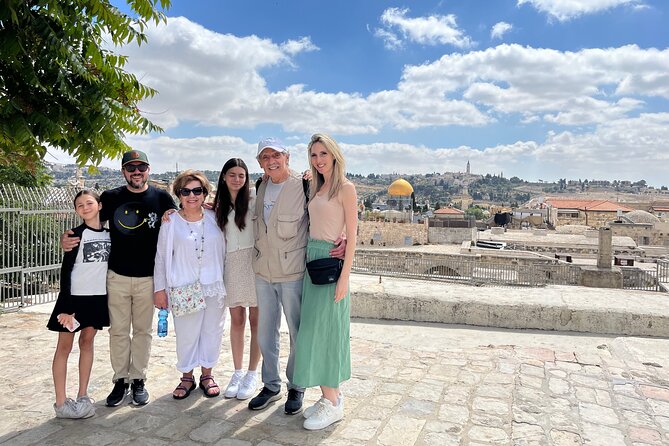
From the roof, you can identify the Old City quarters, Temple Mount, and Mount of Olives. The building itself has an unusual story. You learn why the hotel was built, who built it, how it relates to the Crimean War, and who later blew it up and why.
The hotel also spent 19 years on the border between Jordanian Jerusalem and Israeli Jerusalem. That detail gives the rooftop view a modern political layer. You are not just looking across rooftops. You are seeing a city shaped by division, war, faith, and changing borders.
The tour ends at Notre Dame of Jerusalem Center, on HaTsanhanim Street. The stated opening hours are Monday through Thursday, 9:00 a.m. to 4:00 p.m., for the period listed through June 17, 2026. Confirm the timing when booking, especially if your visit falls near a holiday or outside those hours.
Is $650 a fair price?
The tour costs $650 per group of up to eight people. For a full group, that works out to $81.25 per person. For four people, it is $162.50 each, while a couple would pay $325 each.
That makes the tour most compelling for families or groups of five to eight. You are paying for a private licensed guide, about six hours of concentrated attention, included entry fees, and a route that covers a remarkable number of major sites. The price is harder to justify for two people unless you place a high value on private guiding and tailored discussion.
The included admissions reduce the need to manage separate tickets during the day. Coffee and cake are not included, and you should also plan for your own water and any purchases at the spice shop or market.
Free cancellation is available if you cancel at least 24 hours before the start time. Cancellations within 24 hours are not refunded, and changes during that period are not accepted.
Who should book this Old City tour?
I would choose this tour if you want the major religious sites explained in one connected day rather than visited separately. It suits first-time visitors who want orientation, families with mixed ages, and anyone who prefers asking questions over following a large group.
It is also a strong choice if you care about the human side of Jerusalem. The local cafe, spice tasting, ceramics shop, possible merchant conversations, and stories about individual religious communities keep the day from becoming a procession of famous stones.
You should think twice if you dislike long walks, strict holy-site dress rules, or discussions of religious and political conflict. You should also check the date if Temple Mount access is central to your plans. On closed days, you receive a viewpoint instead.
Should you book it?
Book this private tour if you have four or more people and want a guide-led introduction to Jerusalem’s Old City, especially one that treats Judaism, Christianity, and Islam with equal attention. Orna Simchi’s blend of detailed stories, humor, and flexibility is the main reason to choose it.
For a couple, compare the $650 total with other private options before committing. For a larger group, the math improves quickly, and the included entry fees and six-hour schedule make the price easier to defend. Bring water, a hat, good shoes, and proper clothing, then let the questions lead you through the city.
FAQ
Where does the tour begin?
The tour begins at Jaffa Gate in Jerusalem’s Old City.
Where does the tour end?
The tour ends at Notre Dame of Jerusalem Center, at HaTsanhanim St 3, Jerusalem.
How long does the tour last?
The tour lasts approximately six hours.
How many people can join the private tour?
The price covers one private group of up to eight people.
Is the tour led by a licensed guide?
Yes. Orna Simchi is a licensed guide certified through Israel’s Ministry of Tourism.
Are entry fees included?
Yes. Entry fees are included in the tour price.
Is food or coffee included?
No. Hot drinks and cake are not included.
What should I wear?
Bring clothing that covers the knees and shoulders for the Western Wall and Church of the Holy Sepulchre. Temple Mount requires men to wear pants below the knees and a T-shirt, while women need a long skirt or non-skinny pants and a long-sleeved shirt with no cleavage.
Is Temple Mount open every day?
No. Temple Mount is closed to visitors every Friday, Saturday, and during various Muslim and Jewish holidays. A viewpoint overlooking the site is included instead.
Can the tour be tailored?
Yes. Each private tour can be tailored to your interests and needs.
Just added in Jerusalem
- Walking Jerusalem in Russian★ 5.0 · 1 review
- private Full-Day Tour to Bethlehem and Jerusalem★ 5.0 · 2 reviews
- Jerusalem and Dead Sea Trip from Tel Aviv★ 4.0 · 6 reviews
- Tel Aviv & Old City of Jaffa – Tiny group from Tel Aviv★ 4.5 · 9 reviews
- Tel Aviv; Jaffa Old City, Port & Shuk Hapishpishim Walking Tour★ 4.5 · 11 reviews
- Tel Aviv: Food & History Tour of Jaffa Old City & Flea Market★ 5.0 · 1 review
- Discover the Secrets of the Underground Jerusalem with a private tour★ 5.0 · 4 reviews
- Private Tour from Tel Aviv to Jerusalem★ 5.0 · 3 reviews
Walking Tours in Jerusalem, compared.
Jerusalem Walking Tour: In the Footsteps of Jesus
Read our review →
The Center of the Universe – Walk the “Holy City” with GaryTheGuide
Read our review →
Jaffa: Old City, Port & Shuk Hapishpishim Walking Tour
Read our review →
Browse the lists this tour appears in