
Reviewed · BETHLEHEM AND THE WEST BANK TOURS
Travel to Bethlehem, Jericho and Qaser Al Yahud – Guided Tour From Jerusalem
Three sacred sites, one long day. This shared excursion links Bethlehem, Jericho, and Qaser Al Yahud in about eight to eleven hours, giving you a broad look at Christian traditions, biblical places, and early Islamic archaeology in the West Bank. I like the way it combines major holy sites with less familiar stops such as Hisham’s Palace and Tel es-Sultan.
I especially like the guided Bethlehem visit, where guides such as Elias have been praised for making church history clear, lively, and even funny. I also like the low price of $80, which covers transportation and the Bethlehem guide. The main drawback is that Jericho and the Jordan River are self-guided, while a group of up to 55 people can make the day feel crowded and slow.
If your priority is seeing many important places from Jerusalem without arranging separate transport, this is a useful choice. You should, however, expect a busy schedule, extra entrance fees, a lunch break at your own expense, and a possible wait of 30 to 90 minutes for the Nativity Grotto.
In This Review
- Key points to know before booking
- What the $80 day actually gives you
- Bethlehem begins with the Church of the Nativity
- St. Catherine’s Church and the Cave of Jerome
- The Milk Grotto and a story of refuge
- Shepherd’s Field in Beit Sahour
- A return to Bethlehem’s old city
- Jericho changes the focus from churches to archaeology
- Hisham’s Palace and early Islamic art
- Ancient Jericho at Tel es-Sultan
- Qaser Al Yahud on the Jordan River
- What you will not see at the Mount of Temptation
- Timing, vehicle, and group size
- Guides make the biggest difference in Bethlehem
- Who should book this tour?
- FAQ
- How long does the tour last?
- What is included in the $80 price?
- How much do the Jericho entrance fees cost?
- Is the tour guided in Jericho and at the Jordan River?
- Does the tour visit the Mount of Temptation?
- Can I enter the Nativity Grotto?
- What is the maximum group size?
- Should you book it?
Key points to know before booking
- Bethlehem receives the strongest guiding: The church visits include explanations from a local guide, with Elias, Johnny, and Saint George among the guides praised for clear and entertaining commentary.
- The Nativity Grotto can take patience: On regular days, the wait may be 30 to 90 minutes, and access cannot be guaranteed on Sundays or holidays.
- Jericho is partly self-guided: You visit several major sites, but the included guided service applies to Bethlehem only.
- The tour covers a lot of ground: You see churches, a monastery, an ancient city, an Umayyad palace, and the Jordan River in one full day.
- Bring cash for optional entries: Hisham’s Palace costs 10 NIS, and Tel es-Sultan costs 10 NIS per person.
- The Mount of Temptation is only viewed from below: The tour does not include the cable car or a visit to the mountain.
What the $80 day actually gives you
At $80 per person, this tour offers solid value if you want transportation and a structured route through several places that are difficult to combine on your own. An air-conditioned vehicle carries you between central meeting points in Jerusalem or Bethlehem, and the package includes the Bethlehem guide.
That price does not cover lunch or every admission charge. You should plan for at least 20 NIS in cash for Hisham’s Palace and Tel es-Sultan, although the exact payment arrangements may depend on which sites you enter. The tour also does not include the cable car at the Mount of Temptation.
The value comes from the range of the day. You are not paying for a single monument and a short transfer. You are connecting Bethlehem’s Christian sites with Jericho’s biblical and archaeological remains, then reaching Qaser Al Yahud on the Jordan River.
The tradeoff is personal pace. A private tour would let you linger in the churches, skip places that do not interest you, or spend longer in Jericho. This shared outing is better for someone who wants an efficient overview and does not mind moving with a group.
More Bethlehem and West Bank tours:
- From Tel Aviv: Jerusalem and Bethlehem Guided Day Trip
★ 4.3 · 1,316 reviews - Tel Aviv: Jerusalem, Bethlehem & Dead Sea
★ 4.0 · 881 reviews - Day Tour to Jerusalem and Bethlehem from Tel Aviv
★ 4.5 · 720 reviews
Bethlehem begins with the Church of the Nativity
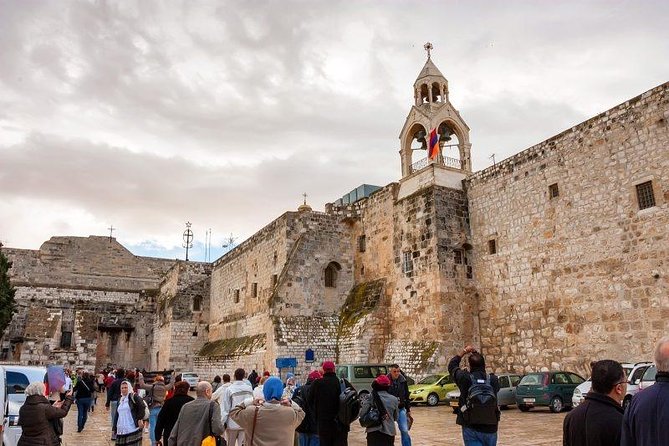
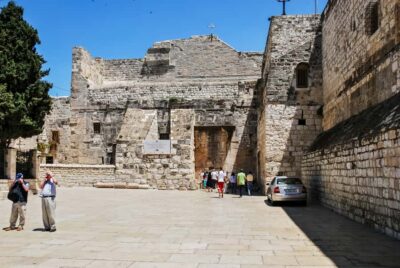
Bethlehem is the heart of the experience. The Church of the Nativity is traditionally identified as the birthplace of Jesus and is one of the oldest working churches in the world. The first church here was built in the fourth century under the Roman Emperor Constantine, above the grotto associated with Mary giving birth.
The planned visit lasts about 40 minutes, but the actual time can change because of the line for the Birth Grotto. On a normal day, you might wait from 30 to 90 minutes. On Sundays and holidays, access to the grotto is not guaranteed, so you should treat the church visit as the main goal and the grotto as a possibility rather than a promise.
That uncertainty matters. If seeing the exact grotto is the central reason you want to visit Bethlehem, a tour with a flexible schedule may suit you better. If you want the setting, the church, and the surrounding sacred quarter, this arrangement still gives you a worthwhile visit even if the line is too long.
A Bethlehem guide adds real value here. Elias has been praised for combining solid explanations with sharp humor, helping the group stay engaged during a stop that can otherwise become a blur of dates, chapels, and religious traditions.
St. Catherine’s Church and the Cave of Jerome
Next to the Nativity Church is St. Catherine’s Church, a Franciscan monastery visited for about 30 minutes. It is associated with a tradition that Christ appeared to St. Catherine of Alexandria and foretold her martyrdom in the early fourth century.
The church also gives access to the Cave of Jerome beneath it. St. Jerome was a Dalmatian priest who lived from 345 to 420 and translated much of the Old Testament from Hebrew and Greek into the Latin Vulgate.
This is a stop where the guide’s explanation helps. Without context, the cave can seem like another small underground chamber. With the story of Jerome’s work, it becomes a place linked to the long process of translating and preserving Christian scripture.
The schedule is brief, so listen closely and avoid expecting a long, quiet visit. This is a sightseeing stop with interpretation, not a private devotional experience.
The Milk Grotto and a story of refuge
The Milk Grotto Church is scheduled for about 25 minutes. Christian tradition identifies the cave as a place where the Holy Family took refuge during the Massacre of the Innocents before fleeing to Egypt.
Its name comes from the story that a drop of Mary’s milk fell onto the cave floor and turned the stone white. The story is devotional rather than historical proof, but it explains the character of the site and why the white stone has such meaning for visitors.
I find this stop useful because it shows how sacred places often carry several layers at once: a physical cave, a religious tradition, and centuries of pilgrimage. You should expect a compact visit, with enough time to understand the site but not enough for a slow, private exploration.
More things to do in Jerusalem:
- From Tel Aviv: Jerusalem Old & New City Bus Tour
★ 4.2 · 824 reviews - From Jerusalem: Masada & Dead Sea Full Day Tour with Pick Up
★ 4.5 · 815 reviews - Masada and the Dead Sea Day Trip from Jerusalem
★ 4.5 · 757 reviews - From Jerusalem: Nazareth and Sea of Galilee Tour
★ 4.5 · 588 reviews
Shepherd’s Field in Beit Sahour
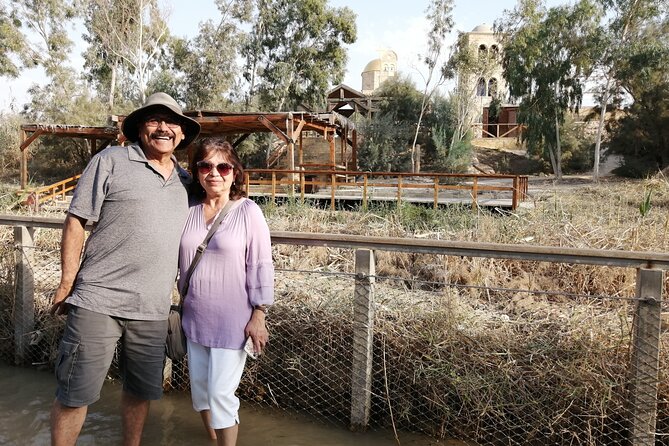
The Chapel of the Shepherd’s Field marks the place where angels are traditionally said to have announced Christ’s birth to shepherds. It is in Beit Sahour, southeast of Bethlehem, in the area known as Shepherds’ Field.
The visit lasts about 35 minutes. Compared with the Nativity Church, this stop usually feels more connected to the surrounding biblical story than to a single dramatic interior. The guide explains the tradition, and you have time to take in the chapel and its setting.
The Bethlehem portion may also include additional religious and cultural points such as the Carmelite tradition connected with Mount Carmel, Aida refugee camp, and Bab idDeir Art Gallery in Bethlehem’s old city. The exact order can change, and not every point is listed as a timed stop, so you should think of them as possible views or brief pass-by points rather than guaranteed lengthy visits.
The art gallery is an independent cultural space in Bethlehem’s historic Deik quarter. Its presence adds a modern Palestinian cultural note to a morning otherwise focused heavily on churches and biblical traditions.
A return to Bethlehem’s old city
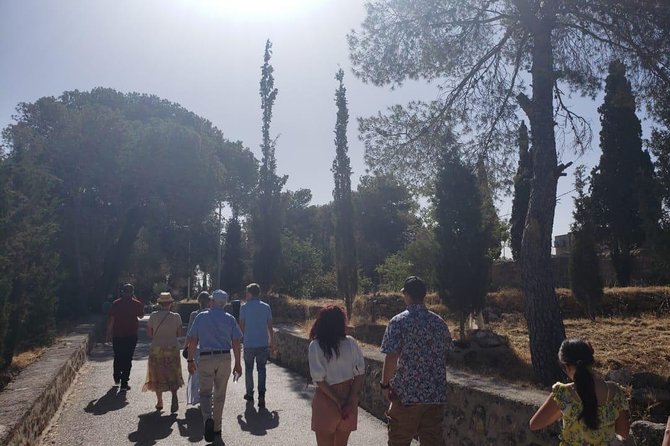
The itinerary includes another 40-minute stop at the Nativity Church area in Bethlehem’s old city. This may overlap with the earlier church visit or reflect additional time in the sanctuary area, depending on the day’s organization.
That flexibility is normal on a shared tour. Lines, traffic, border procedures, worship services, and the size of the group can all affect the order. If you need every stop to follow a precise timetable, this may feel loose. If you care more about seeing the main places than ticking off exact minutes, the arrangement is easier to accept.
The Bethlehem morning is the most guided and organized part of the trip. This is where guides such as Elias, Johnny, and Saint George have received the most praise. Their explanations and humor can make a major difference, especially when the group is large.
Jericho changes the focus from churches to archaeology
After Bethlehem, the day shifts toward Jericho. The Monastery of Saint Gerassimos, also called Deir Hajla or Deir Hijleh, is a Greek Orthodox monastery in the Jericho Governorate, west of the Jordan River and north of the Dead Sea.
The stop lasts about 15 minutes, and admission is not included. That is a short visit, so you should not expect a full monastery tour or a long period for quiet reflection. It works better as a brief introduction to the religious sites around Jericho.
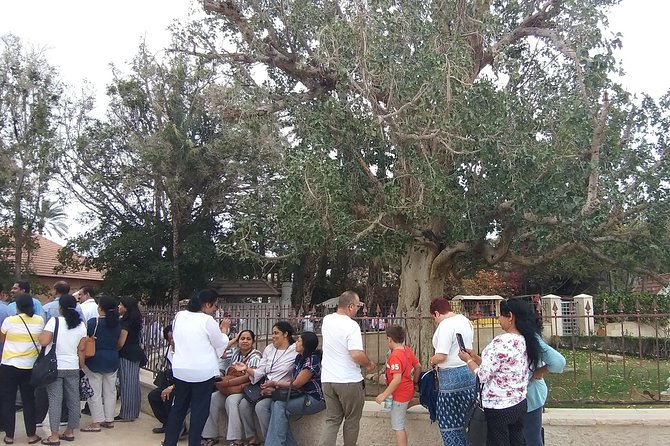
Jericho itself is traditionally associated with the story of Zaccheus, the wealthy chief tax collector who climbed a sycamore tree to see Jesus passing by. The tree linked with that story is visited for about 15 minutes.
The Zaccheus stop is simple and symbolic. You are not visiting a large archaeological complex. You are seeing a tree connected with a familiar Gospel account and hearing how the story describes Zaccheus changing his life after meeting Jesus.
Hisham’s Palace and early Islamic art
Hisham’s Palace is one of the day’s most valuable additions for anyone who wants more than biblical sites. The complex at Khirbat al-Mafjar, about five kilometers north of Jericho, dates to the first half of the eighth century and is associated with the Umayyad dynasty.
The stop is scheduled for about 30 minutes. Admission costs 10 NIS and is not included, so bring cash. The site is known for archaeological remains and fine mosaics from the Byzantine period, along with evidence of the early Islamic period.
Thirty minutes is enough for a useful look, but not a detailed archaeological study. Since the Jericho portion is self-guided, you may need to read signs or rely on the guide’s general direction rather than expect the same close commentary provided in Bethlehem.
This is one place where I would gladly trade a little extra time for a slower visit. Still, including Hisham’s Palace at this price gives the tour more range. You see how the region’s story continues beyond the Christian sites.
Ancient Jericho at Tel es-Sultan
Tel es-Sultan, also known as Ancient Jericho or Tell Jericho, is the archaeological site linked with ancient and biblical Jericho. It lies about two kilometers north of modern Jericho and is recognized as a UNESCO-nominated site.
The visit lasts about 30 minutes, with an entrance fee of 10 NIS per person. You should bring cash and keep your expectations realistic. This is not a fully guided archaeological walk, and the time is short.
The importance of Tel es-Sultan is its age and connection to the long settlement story of Jericho. You are looking at a place associated with one of the world’s oldest known cities, rather than simply visiting a biblical viewpoint.
A museum connected with the Jericho area displays archaeological remains, including Byzantine mosaics. One section covers the Samaritan community, its history, and its customs. The provided schedule does not give a timed museum stop, so do not assume you will have a long museum visit, but the information adds useful context to the region.
Qaser Al Yahud on the Jordan River
The final major stop is Qaser Al Yahud, the Jordan River baptismal site. The visit lasts about 30 minutes, with around 15 minutes specifically allocated to the river.
This is a meaningful stop for Christian visitors because the Jordan River is connected with baptismal traditions and the ministry of John the Baptist. The visit is short and self-guided, so you should not expect a formal religious service or a long guided explanation.
You may find this part of the day quieter and more personal than the church visits, simply because the schedule leaves room to look at the river and consider its importance. The time is limited, though. If you want a long period at the water, this itinerary will feel rushed.
What you will not see at the Mount of Temptation
The Mount of Temptation rises near Jericho and is associated with the tradition that Jesus spent 40 days and 40 nights in the wilderness after his baptism. The mountain overlooks the Jordan Valley and the Judean Desert.
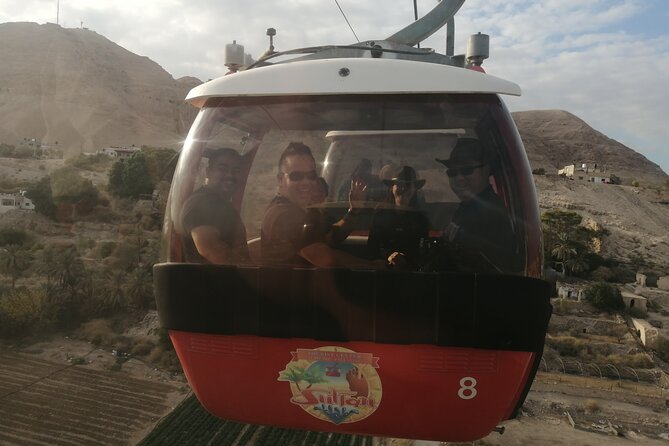
This tour does not take the cable car and does not visit the mountain itself. You may see it from the Jericho area, but you should not book this experience expecting a ride or a stop at the monastery on the mountain.
That omission keeps the price down and helps fit Bethlehem, Jericho, and Qaser Al Yahud into one day. If the Mount of Temptation is your main Jericho interest, choose an excursion that names the cable car or mountain visit specifically.
Timing, vehicle, and group size
The full day lasts approximately eight to eleven hours. That broad range tells you something important: the schedule depends on traffic, lines, border and checkpoint conditions, group movement, and the time spent at the Nativity Grotto.
The air-conditioned vehicle is a practical benefit, particularly on a day with repeated transfers. The group can reach a maximum of 55 people, which is large. You may spend more time waiting for people to board, gather, or finish at a stop than you would on a small-group outing.
Central meeting points are available in Jerusalem or Bethlehem. The tour is also near public transportation, which helps if you are staying outside the immediate pickup area. Confirmation is received at booking, and free cancellation is available until 24 hours before the start time. Changes or cancellations inside that period are not accepted for a refund.
Most people can take part, but the long day and frequent stops favor anyone comfortable with a full schedule. The experience is not designed around extended rest periods.
Guides make the biggest difference in Bethlehem
The strongest part of the experience is the quality of the local guiding in Bethlehem. Elias is repeatedly praised for being informative, engaging, and funny. Johnny and Saint George are also singled out for making the day enjoyable, while Amir has been praised for his work around Jericho and the Jordan River.
Guide assignments can change, so you should not book on the assumption that one specific person will lead your group. Still, the pattern is clear: a good guide helps turn a series of churches into a connected story.
The contrast with Jericho is worth noting. Bethlehem includes a guided tour, while Jericho and the Jordan River are self-guided. That means you receive the most interpretation where the religious details are dense, then more freedom and less explanation later in the day.
Who should book this tour?
I would choose this tour if you want to cover the main highlights from Jerusalem in one day, prefer not to arrange West Bank transport yourself, and enjoy having a local guide explain Bethlehem’s sacred places.
It suits first-time visitors, Christian pilgrims who want the major Bethlehem sites, and anyone interested in combining religion, archaeology, and modern Palestinian culture. It also works well if $80 is your target budget and you are comfortable paying modest extra entrance fees.
I would look elsewhere if you want a small group, a slow pace, a fully guided Jericho visit, or a guaranteed visit to the Nativity Grotto. You should also avoid it if the Mount of Temptation cable car is essential to your plan.
FAQ
How long does the tour last?
The experience lasts approximately eight to eleven hours. The final duration can vary because of traffic, lines, group movement, and time spent at the Church of the Nativity.
What is included in the $80 price?
The price includes an air-conditioned vehicle and a guided tour in Bethlehem. It does not include lunch, Hisham’s Palace admission, or Tel es-Sultan admission.
How much do the Jericho entrance fees cost?
Hisham’s Palace costs 10 NIS, and Tel es-Sultan costs 10 NIS per person. Bring cash for these charges.
Is the tour guided in Jericho and at the Jordan River?
The Jericho and Jordan River portions are self-guided. The included guided tour applies to Bethlehem only.
Does the tour visit the Mount of Temptation?
No. The tour does not visit the Mount of Temptation and does not include the cable car.
Can I enter the Nativity Grotto?
You may be able to enter, but access is not guaranteed on Sundays or holidays. On regular days, the wait can be 30 to 90 minutes.
What is the maximum group size?
The tour can include up to 55 people. It is a shared excursion using an air-conditioned vehicle.
Should you book it?
Book this excursion if you want a wide-ranging, budget-friendly day with Bethlehem as the main guided experience and Jericho as an archaeological and biblical add-on. The guides can make the Bethlehem portion memorable, and the route gives you far more than a single holy-site visit.
Go in prepared for a long day, a large group, extra cash expenses, and limited guiding after Bethlehem. For $80, that is a fair exchange for reaching three important areas from Jerusalem without managing the transport yourself.
Just added in Jerusalem
- Walking Jerusalem in Russian★ 5.0 · 1 review
- private Full-Day Tour to Bethlehem and Jerusalem★ 5.0 · 2 reviews
- Jerusalem and Dead Sea Trip from Tel Aviv★ 4.0 · 6 reviews
- Tel Aviv & Old City of Jaffa – Tiny group from Tel Aviv★ 4.5 · 9 reviews
- Tel Aviv; Jaffa Old City, Port & Shuk Hapishpishim Walking Tour★ 4.5 · 11 reviews
- Tel Aviv: Food & History Tour of Jaffa Old City & Flea Market★ 5.0 · 1 review
- Discover the Secrets of the Underground Jerusalem with a private tour★ 5.0 · 4 reviews
- Private Tour from Tel Aviv to Jerusalem★ 5.0 · 3 reviews
Bethlehem and the West Bank Tours, compared.
Day Tour to Jerusalem and Bethlehem from Tel Aviv
Read our review →
Jerusalem, Dead Sea, and Bethlehem from Tel Aviv
Read our review →
Jerusalem and Bethlehem Day Tour from Jerusalem
Read our review →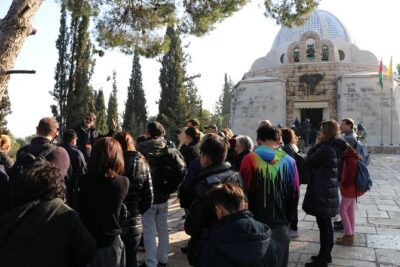
Travel to Bethlehem Half Day Guided Tour from Jerusalem & TelAviv
Read our review →
Ashdod Shore Excursion: Jerusalem and Bethlehem – for cruise ship guests only
Read our review →Browse the lists this tour appears in